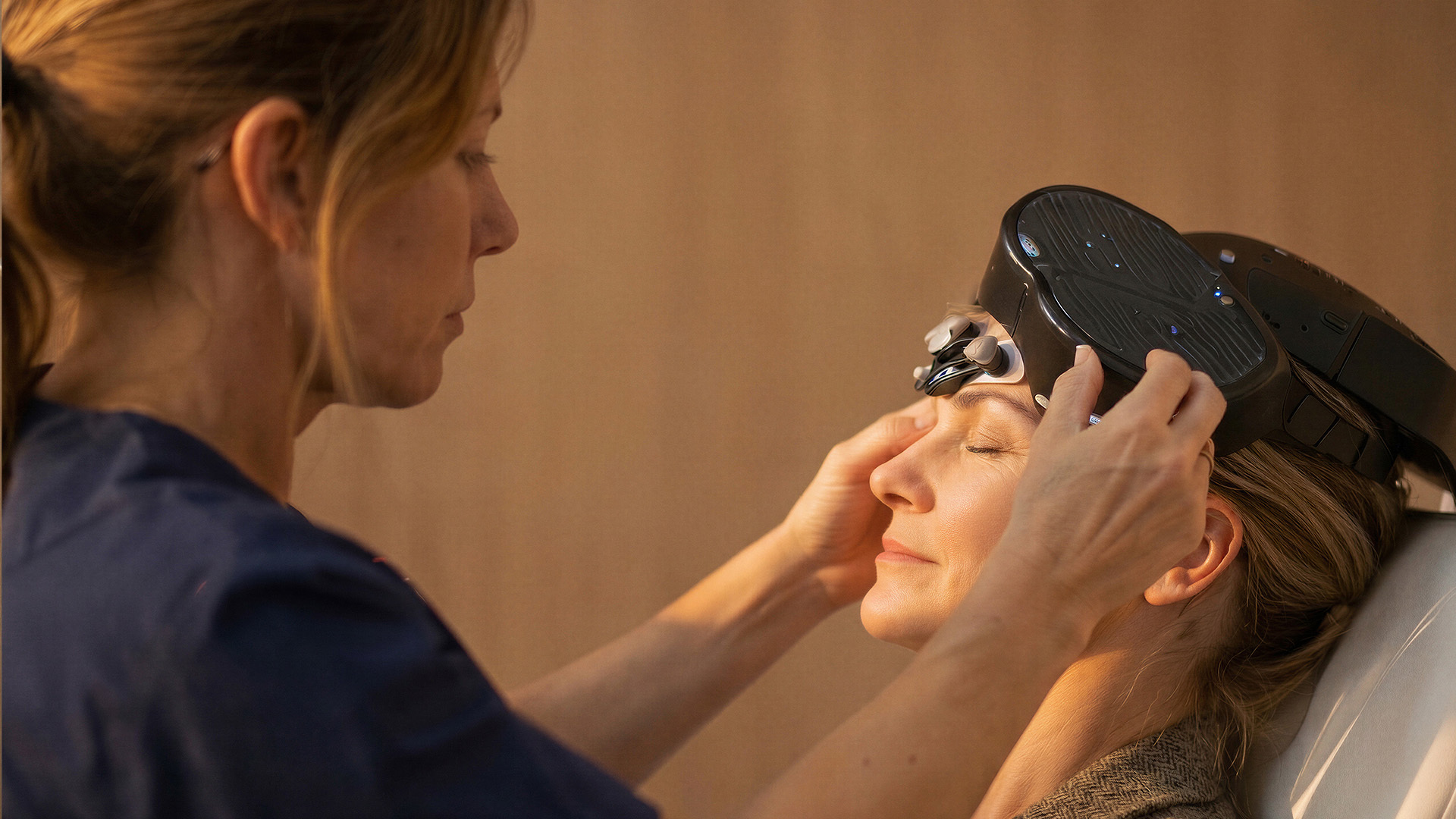
Treating obsessive-compulsive disorder with transcranial magnetic stimulation (TMS)
OCD can be managed. If medication and therapy haven't given you the relief you hoped for, neuromodulation treatments act on the brain circuits involved in OCD. Here we explain what they are and whether they're right for you.
What is obsessive-compulsive disorder (OCD)?
OCD is a mental health disorder with two elements: obsessions —intrusive, recurrent and unwanted thoughts, images or urges that cause intense anxiety— and compulsions —behaviors or mental rituals performed to relieve that anxiety—. It affects about 1-2% of the population and usually begins in adolescence or young adulthood.
It isn't about quirks or being "too tidy". OCD can consume hours a day, interfere with work, studies and relationships, and cause great suffering. The good news is that it's treatable.
We talk about treatment-resistant OCD when symptoms persist despite adequately following first-line therapies —medication and specialized psychotherapy—. For those patients, neuromodulation techniques have become an increasingly supported alternative.

Symptoms of OCD: do you recognize yourself?
OCD shows up in a wide variety of obsession and compulsion patterns. These are some of the most common; if they interfere with your daily life, it's worth talking to a professional.
- Fear of contamination and excessive washing or cleaning
- Repeated checking (doors, gas, appliances)
- Need for symmetry, order or exactness
- Intrusive thoughts of an aggressive, sexual or blasphemous nature
- Constant doubt and reassurance-seeking
- Mental rituals: counting, repeating phrases, praying
- Hoarding worthless items
- Avoiding situations that trigger obsessions
OCD has effective treatment: recognizing the symptoms is the first step.
Why does OCD treatment sometimes not work?
First-line treatment for OCD combines high-dose SSRI antidepressants and psychotherapy with exposure and response prevention (ERP). It's effective for many people, but not for everyone: a significant share of patients don't achieve sufficient symptom control even when following treatment correctly.
OCD is linked to overactivity in specific brain circuits, particularly the cortico-striato-thalamo-cortical loop, involved in error detection and habit formation. When medication and therapy can't regulate that activity, therapies that modulate those circuits directly, such as transcranial magnetic stimulation, can offer a complementary route.
Treatment options for resistant OCD
When first-line treatment isn't enough, several alternatives exist, often combinable:
Medication optimization
Adjusting the SSRI dose, switching medication or adding augmenting agents under psychiatric supervision. It's the usual next step.
Intensive ERP therapy
Exposure and response prevention is the reference psychological treatment for OCD. Increasing its intensity or changing format can improve response.
Transcranial magnetic stimulation (TMS)
A non-invasive technique that modulates the activity of the circuits involved in OCD. Its deep form has FDA clearance for this indication since 2018.
The most suitable combination depends on your clinical history. A specialist must assess your case before recommending any treatment.
The Connectoma approach: TMS for OCD
At Connectoma we apply transcranial magnetic stimulation to modulate the brain circuits involved in OCD —mainly the loops connecting the prefrontal cortex with deeper structures that sustain obsessions and compulsions. Treatment is delivered in short outpatient sessions, is non-invasive, requires no anesthesia and is compatible with your medication and exposure therapy, which it complements rather than replaces. A specialist assesses each case and defines the protocol and number of sessions.
How transcranial magnetic stimulation (TMS) works
Read the full articleYour Path to well-being

Professional diagnosis
A specialist assesses your case, reviews your history and confirms whether TMS is a suitable option for you.
Treatment plan
Our team defines the protocol, number of sessions and schedule that best fit your situation.

Guided Treatment
We apply transcranial magnetic stimulation (TMS) in short outpatient sessions, with no anesthesia or hospital admission.

Close Follow-up
We accompany you throughout the process, evaluating your progress and adjusting treatment if necessary.
What does the science say?
Transcranial magnetic stimulation has been shown to reduce obsessions and compulsions in OCD, and its deep form has FDA clearance for this indication since 2018. Precision neuromodulation research —the same that underpins the Connectoma Protocol in depression— is advancing to personalize OCD treatment too, guiding it by individual brain activity.
Explore the scientific evidenceIs TMS right for your OCD?
- You have a diagnosis of OCD confirmed by a professional.
- You've followed medication and/or ERP therapy without the improvement you hoped for.
- You're looking for a non-invasive alternative without systemic side effects.
- You want a treatment compatible with your medication and psychotherapy.
A specialist will assess your case individually to confirm suitability. TMS does not replace medical evaluation or therapy.

Questions about OCD treatment
It's OCD whose symptoms persist despite correctly following first-line treatment: adequate-dose SSRIs and exposure and response prevention therapy. In these cases, neuromodulation techniques such as TMS can be an alternative.
No. TMS is non-invasive and painless. During the first sessions some people notice a slight tapping sensation on the scalp that usually fades quickly. You can return to your routine immediately after.
No. TMS is complementary: you can continue your medication and psychotherapy while receiving treatment. In fact, combining it with ERP therapy can enhance results.
Yes. Deep transcranial magnetic stimulation has had FDA clearance for treating OCD since 2018. At Connectoma we apply TMS for OCD following the protocols backed by current evidence.
Each session lasts 10 to 20 minutes. The total number of sessions and their schedule depend on the protocol indicated for your case, which the medical team defines after the assessment.
Adverse effects are minimal and temporary. The most common is mild scalp discomfort or a slight headache after the session.
The price depends on the center and the protocol indicated for your case. During the initial no-obligation assessment, our team will inform you of the cost and the options available.
Conventional TMS for depression uses a generic target; Connectoma's personalized, neuroimaging-guided protocol is currently specific to depression. For OCD, Connectoma applies TMS on the circuits involved in the disorder following the protocols supported by current evidence, always as a complement to therapy and medication.
At partner clinics and medical centers that meet Connectoma's quality and safety standards. We can point you to the nearest center during your assessment.
Keep learning
Clear resources to understand your treatment.
Take the first step to manage your OCD
Talk to our team, no strings attached, and find out if TMS can help you.
This page is for informational purposes and does not replace professional medical advice. If you think you may have OCD, consult a healthcare professional. Connectoma's intensive protocol has the strongest evidence in depression; in OCD, TMS is applied according to the available evidence and as a complementary treatment. No treatment guarantees remission.